By
By 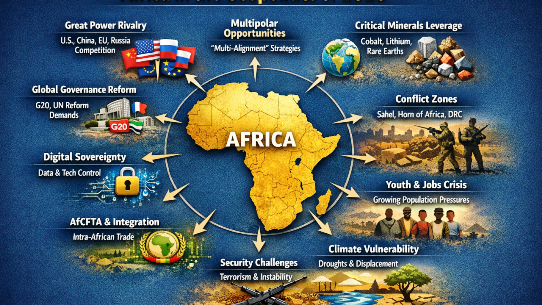
By Dr. Theogene Rudasingwa, Founder, Eastern Africa Meta-University EAMU
Africa at the Crossroads of a Fracturing World: Standing in the Geopolitics of 2026
The world is entering 2026 in a state of profound geopolitical disquiet. The post–Cold War order—already weakened by financial crises, pandemics, and climate shocks—is now openly fragmenting under the weight of great-power rivalry, regional wars, economic nationalism, and technological disruption. Multilateral institutions struggle to keep pace.
Norms once assumed to be settled—respect for sovereignty, restraint in the use of force, rules-based trade—are increasingly contested or ignored.
What is emerging is not yet a coherent new order, but something more unstable: a multipolar world marked by overlapping crises, strategic mistrust, and transactional alliances. The rivalry between the United States and China continues to shape global economics, technology, and security.
Europe is preoccupied with war on its eastern flank and energy security. Russia, constrained but disruptive, leverages conflict and uncertainty. Middle powers—from India and Turkey to the Gulf states—are asserting themselves with increasing confidence.
In this environment, the Global South is no longer peripheral. It is central terrain. And Africa, with its people, resources, geography, and future potential, stands at the very heart of this global contest.
Yet Africa’s position in 2026 is not preordained. A tension between vulnerability and leverage, fragmentation and possibility shapes it. Whether Africa emerges as a strategic actor or remains a strategic object will depend less on external powers than on African choices, leadership, and coherence.
Africa has become a major arena of geopolitical competition
First, Africa has become a major arena of geopolitical competition. The continent is courted simultaneously by Western powers, China, Russia, the Gulf states, Turkey, and emerging Asian economies. This attention reflects Africa’s growing strategic value—but it also carries risks.
Competition among external actors can empower African states to negotiate better terms, but it can also deepen elite capture, fuel proxy conflicts, and entrench extractive relationships. The challenge is to convert attention into agency.
Second, the shift toward a multipolar world creates space for African strategic autonomy. Unlike the rigid blocs of the Cold War, today’s geopolitical landscape allows room for multi-alignment. African states are no longer compelled to choose a single patron.
Many are already diversifying partnerships across security, trade, infrastructure, and technology. This flexibility can be a source of strength—if guided by clear national and continental strategies rather than short-term political survival.
Africa’s critical minerals at the heart of global energy transition
Third, Africa’s critical minerals place it at the center of the global energy transition and technological race. Cobalt, lithium, copper, rare earths, and graphite—essential for electric vehicles, batteries, renewable energy, and advanced electronics—are concentrated disproportionately on the continent.
This gives Africa leverage unprecedented in modern history. But leverage is only power if it is organized. Exporting raw materials without building value chains risks reproducing the very dependency Africa seeks to escape.
Fourth, persistent insecurity remains Africa’s most serious geopolitical liability. From the Sahel and the Horn of Africa to eastern Democratic Republic of Congo and Sudan, conflict undermines development, fragments states, and invites external military involvement.
The growing presence of private military actors and ad hoc security arrangements reflects both global disorder and regional institutional weakness. Without political settlements, accountable governance, and credible regional security mechanisms, Africa risks being framed internationally as a zone of instability rather than opportunity.
Africa’s demography is its greatest asset and most urgent challenge
Fifth, Africa’s demography is both its greatest asset and its most urgent challenge. By 2026, Africa will remain the youngest continent in the world. This youth bulge can drive innovation, productivity, and global labor markets—or it can fuel unemployment, migration crises, and political unrest. The difference lies in education, job creation, and inclusion. Demography is destiny only if policy fails.
Sixth, economic fragmentation at the global level makes African regional integration more—not less—important. As global trade becomes more protectionist and bloc-based, Africa’s ability to trade with itself will determine its resilience.
The African Continental Free Trade Area, coupled with regional integration efforts, offers a historic opportunity to build regional value chains, strengthen bargaining power, and reduce vulnerability to external shocks. Its success will depend on political will, infrastructure, and implementation—not declarations.
Africa stands on the frontline of climate change
Seventh, Africa stands on the frontline of climate change. Although it has contributed least to global emissions, it bears disproportionate costs through droughts, floods, food insecurity, and displacement.
This reality gives Africa moral authority in global climate negotiations, but moral authority must be matched by strategic coherence.
Climate adaptation, development, peacebuilding, and finance reform must be pursued as a single agenda.
Dgital sovereignty is emerging as a new frontier of power
Eighth, digital sovereignty is emerging as a new frontier of power. Data, artificial intelligence, digital public infrastructure, and surveillance technologies will shape Africa’s future governance and economic prospects. Without clear rules and continental coordination,
Africa risks becoming a digital colony—its data extracted, its societies monitored, its technologies imported wholesale. With foresight, Africa can instead build digital systems that serve citizens, protect rights, and foster innovation.
Finally, Africa’s role in global governance is evolving—but incomplete. Greater representation in global forums is a step forward, but representation without influence is insufficient. The real question is whether Africa can move from agenda-taking to agenda-setting, from symbolic inclusion to coalition leadership.
In 2026, Africa will be too important to ignore, too young to sideline, and too resource-rich to remain peripheral. But it will not automatically rise. The decisive question is whether African leaders and societies choose fragmentation or coordination, extraction or transformation, reaction or strategy.
The map at the center of today’s geopolitics is no longer drawn solely in Washington, Beijing, or Brussels. It runs through Africa. The question is whether Africa will allow others to draw it—or will finally draw its own.