By
By 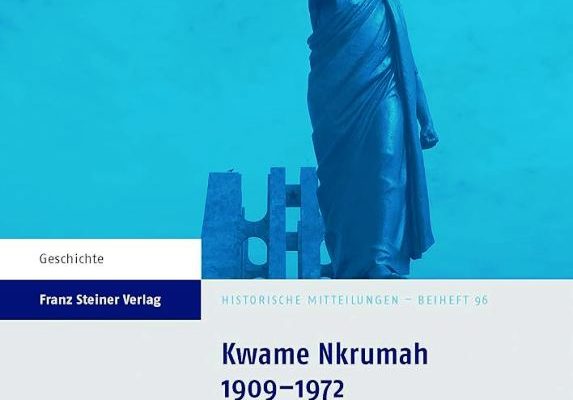
Sixty years after the coup d’etat that on 24 February 1966 removed from power Ghana’s president, Kwame Nkrumah, and the government run by his Convention People’s Party, history professors Bea Lundt and Christoph Marx have edited “Kwame Nkrumah, 1909–1972: A Controversial Visionary” to evaluate his leadership style, overall accomplishments, and impact.
While Lundt’s teaching and research specialize in precolonial and postcolonial studies, gender and diversity, West African culture and history, and narratives of Europe and Africa, Marx writes on colonial history and historiography.
The coeditors divide the book into three sections: visions and politics (pp. 19–66), opposition and coup (pp. 66–136), and evaluation and memory (pp. 137–204), preceded by an introduction (pp. 7–16) and followed by information on the contributing essayists (pp. 205–208).
An influential and controversial politician on the African continent in the 20th century
Lundt and Marx confirm their intent and purpose thus: “This anniversary [of the overthrow ofNkrumah] is an occasion to look at the political biography and the impact of one of the most influential and controversial politicians on the African continent in the 20th century” (p. 7). It is impressive that several indigenous Ghanaian scholars have made insightful contributions to the volume.
They include Cyrelene Amoah-Boampong of the University of Ghana’s history department; Kofi Darkwah of the University of Education in Winneba, Ghana; Kwame Osei Kwarteng of the University of Cape Coast; Samuel Aniegye Ntewusu of the Institute of African Studies at the University of Ghana; Nana Yaw B. Sarpong of the University of Ghana’s history department; and Mary Seiwaa Owusu of the University of Cape Coast’s history department.
Lundt and Marx, the book’s editors, are German scholars with strong research interests in postcolonial Africa. Lundt, who is currently retired, has been affiliated with the European University of Flensburg and Humboldt University, and Marx is affiliated with the Historical Institute of the University of Duisburg-Essen, both in Germany.
Knowledgeable non-Ghanaian scholars who have contributed to the volume include Harcourt Fuller, a graduate of the London School of Economics, who currently teaches history at Georgia State University in Atlanta; Carola Lentz, whose book “Land, Mobility, and Belonging inWest Africa” (Indiana University Press, 2013) won the ASA’s Melville Herskovits Award, is aprofessor in the anthropology and African studies department of Johannes Gutenberg University in Mainz; Felix Muller, whose PhD dissertation on Ghanaian intellectual and political history, has been affiliated with the Center for Area Studies at Leipzig University; Jonathan Otto Pohl has been a lecturer in the University of Ghana’s history department since 2011; and Arno Sonderregger is a senior lecturer in the department of African studies of the University of Vienna.
A comparative study of the pan-Africanism that Nkrumah and George Padmore promoted
Among the thematic essays in the book is a comparative study of the pan-Africanism that Nkrumah and George Padmore promoted. In this study, Sonderregger describes both pan-Africanists as “outstanding agents and symbols of the anti-imperialist and anti-colonial struggle”(p. 19).
Darkwah revisits the Kwame Nkrumah Ideological Institute, which was based in Winneba and was meant to train Convention People’s Party activists, with fresh analysis. Amoah-Boampong provides a timely discussion of the place that women occupied in Ghana in the Nkrumah era; he contends that “in contrast to the colonial state’s hegemony and political marginalization of women, the Nkrumah regime exploited and improved gender equality and equity” (p. 49).
Another topical essay that readers can look forward to is Pohl’s discussion of the coup that ousted Nkrumah: relying on the Freedom-of-Information Act to access research materials, Pohl confirms the role the CIA played in the context of Cold War politics to help Ghanaian military and police operatives get rid of Nkrumah while he was out of the country on a peace mission in Vietnam.
In contrast, John Stockwell, a former CIA operative (as an Angola desk officer), in his own book, “In Search of Enemies: A CIA Story (1984), has written that the CIA officials in the USA embassy in Accra merely encouraged the anti-Nkrumah plotters and were not active participants. Instead, Pohl contends that the American role in Ghana’s 1966 coup “fits into the larger pattern of Ghana and other countries in Africa, Asia, and Latin America [which were] moving politically closer to the USSR and away from the US during the 1960s” (p. 119).
CIA’s role “fits into the larger Cold War strategy of the US towards Africa
Pohl shows that the CIA’s role “fits into the larger Cold War strategy of the US towards Africa and other regions of the Third World” (p. 119). In “Atomic Africa,” Harcourt Fuller gives credit to Nkrumah’s anti-neocolonial stance, stressing that Nkrumah reasoned that countries like Ghana “needed a technological and scientific Great Leap Forward to develop their own societies and escape the grips of Western neo-colonialism” (p. 185).
Readers of “Kwame Nkrumah, 1909–1972: A Controversial Visionary” should benefit tremendously from the scholarly contributions to the volume, which can play complementary roles in the research of pan-Africanists, historians, and many other scholars. Reading the book brings into sharp focus Frantz Fanon’s insightful observation in “The Wretched of the Earth” (1968): “Each generation must out of relative obscurity discover its mission, fulfill it, or betray it” (p. 206).
Whatever one’s opinion about Nkrumah’s leadership, one cannot by any means dispute that he had a genuine and sincere commitment to postcolonial Africa’s struggle for economic development and nation-building. He indeed had a mission, and he tried to fulfill it, even though some felt the global social order might be threatened by the success of his vision.
The major question this book provokes us to ask is: can we say that today’s generation of African leaders all have the kind of mission that Nkrumah had? If not, why?
Courtesy: Samuel Zalanga’s Post