By
By 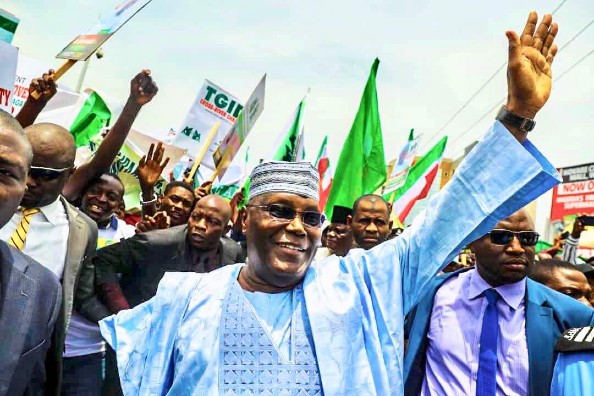
By Mkpe Abang
Something curious has taken hold of Nigeria’s political atmosphere ahead of the 2027 elections. Across television studios, newspaper columns, political gatherings, social media spaces, and even among self-appointed commentators seeking relevance in an increasingly noisy public sphere, one phrase now echoes almost ritualistically:
“Atiku should step down.”
The frequency, intensity, and sometimes desperation with which this demand is repeated raise deeper questions beyond the candidacy of one man. Why has the political participation of Alhaji Atiku Abubakar, former Vice President of Nigeria, become such a source of agitation among political actors who ought ordinarily to celebrate democratic competition? Why does the mere prospect of an Atiku candidacy appear capable of unsettling both ruling party strategists and segments of the opposition alike?
Democracy Versus Citizens’ Constitutional Right to Seek Office Free from Pressure to Withdraw
More fundamentally: what exactly is democracy if citizens can no longer freely exercise their constitutional rights to seek office without coordinated pressure campaigns demanding withdrawal before the electorate even speaks?
These questions go beyond Atiku himself. They strike at the heart of Nigeria’s democratic culture. For decades, Nigeria struggled under military authoritarianism precisely because the people were denied the right to choose their leaders.
The transition to democratic governance was supposed to establish one foundational principle above all others: sovereignty belongs to the people. In a democracy, it is the electorate – not commentators, pressure groups, sectional propagandists, or political merchants masquerading as patriots – that ultimately decides who governs.
Yet increasingly, public discourse around Atiku Abubakar appears to suggest a different philosophy: that certain individuals must be pressured, morally blackmailed, regionally profiled, or politically cornered into withdrawing from democratic contests to satisfy elite calculations or manufactured sentiments. That is dangerous.
Democracy’s Foundation: Competition, Not Entitlement
What makes the situation even more curious is that many of those calling on Atiku to “step down” often do not articulate clearly for whom exactly he should step aside. Step down for whom? By what democratic principle? By what constitutional logic? By what moral authority?
Democracy is not built around entitlement. It is built around competition.
If a politician believes he possesses superior ideas, broader national appeal, stronger organisational capacity, or greater electoral acceptability, the democratic pathway is straightforward: contest and win. Convince delegates. Persuade party members. Mobilise voters. Build coalitions. Campaign effectively. That is democracy.
What is not democracy is the attempt to delegitimise a citizen’s right to contest simply because his candidacy appears politically formidable. And perhaps that is the real issue.
Perhaps the Atiku candidacy alone represents a greater political force than many competing opposition tendencies combined. Perhaps some actors within the ruling establishment, increasingly aware of mounting public dissatisfaction over economic hardship, insecurity, inflation, unemployment, and governance anxieties, recognise the dangers posed by a formidable opposition figure like Atiku, with national structures, experience, name recognition, and political resilience.
Fear of Atiku Fuels Anti-Democratic Impulses Masked as Democratic Worries
One need not fully subscribe to conspiracy theories to acknowledge the obvious realities of political strategy. Across democracies worldwide, incumbents often seek to shape opposition dynamics indirectly – through media narratives, elite persuasion, strategic leaks, sponsored commentators, or subtle amplification of division within rival coalitions. Politics is not played in innocence.
What is remarkable in Nigeria’s current atmosphere is how openly anti-democratic impulses now sometimes disguise themselves as democratic concern.
There is hardly any major democracy where experienced politicians are routinely told they have no right to contest because “it is someone else’s turn.” Elections are not inheritance ceremonies. They are competitive exercises.
The obsession with Atiku “stepping down” therefore reveals something psychologically deeper within sections of the political establishment and commentariat: fear. Fear of political weight. Fear of organisational reach. Fear of electoral experience. Fear of a candidate whose political longevity itself speaks to unusual resilience within Nigeria’s turbulent political terrain.
Atiku Abubakar: A Defining Pillar of Nigeria’s Fourth Republic
Love him or dislike him, Atiku Abubakar remains one of the most enduring political figures in Nigeria’s Fourth Republic. Since the return to democracy in 1999, he has remained consistently relevant across changing political cycles, alliances, and party realignments. Very few politicians in contemporary Nigeria possess comparable national networks extending across regions, demographics, and political tendencies. That longevity itself explains why his name continues to dominate political calculations.
Indeed, some political analysts have quietly argued that the movement of certain opposition figures away from coalition possibilities may partly reflect concerns about Atiku’s dominance within any open delegate contest. Whether such claims are entirely accurate is secondary. The perception itself is revealing.
After all, throughout the PDP primaries and subsequent coalition discussions across opposition circles, Atiku’s core democratic argument has remained remarkably consistent: let the delegates decide. That is not authoritarianism. That is procedural democracy.
If party delegates vote against him, then democracy has spoken. If voters reject him in a general election, democracy has spoken. But demanding that a candidate should not even contest because others feel uncomfortable with his political strength or weight fundamentally undermines democratic culture. This is where Nigeria must tread carefully.
No Democracy Can Thrive If Running for Office Requires Elite Permission
Democracy cannot survive if electoral participation becomes conditional upon elite approval. Once political actors begin determining who should or should not contest outside constitutional processes, democracy slowly mutates into managed selection disguised as open competition. And Nigeria has experienced enough of that already.
The irony is especially striking given the historical trajectory of Nigerian politics. Many of the same voices today advocating “consensus by pressure” previously condemned imposition, godfatherism, and anti-democratic manipulation within political parties. Yet asking a candidate to withdraw simply because others desire “their turn” or fear electoral defeat reproduces the same anti-democratic logic under a different name.
There is also a troubling regional undertone that occasionally enters these discussions. Certain arguments subtly imply that political offices should rotate according to emotional entitlement rather than electoral merit or democratic persuasion.
Power Balancing Matters in Plural Societies. But No Substitute for Democratic Competition
While power balancing remains an important political reality in plural societies like Nigeria, it cannot permanently replace democratic competition itself. Otherwise, elections become ceremonial endorsements of predetermined arrangements rather than genuine exercises in popular sovereignty.
A democracy where citizens are psychologically intimidated away from contesting ceases gradually to be a democracy of choice. It becomes democracy by negotiation among elite gatekeepers. The danger of this trend extends beyond Atiku Abubakar.
Tomorrow, it could be another politician. Another region. Another candidate. Another citizen deemed “too strong,” “too controversial,” “too experienced,” “too ambitious,” or simply inconvenient to prevailing elite interests. That slippery slope is dangerous for constitutional democracy.
Democracies Weaken in the Absence of Political Competition
Moreover, political competition itself strengthens democracy. Strong candidates force stronger debates. They compel parties to organise better. They energise public participation. They sharpen policy discussions. Democracies become weaker – not stronger – when major contenders are pressured out before the people speak.
One of the paradoxes of Nigerian politics is that politicians are often criticised simultaneously for lacking ideology and for refusing to withdraw from competition. Yet democratic systems are designed precisely to allow multiple ambitions, competing visions, and rival coalitions to test themselves before the electorate.
No candidate is owed victory. No candidate is owed withdrawal. The people decide.
It is also worth remembering that democratic legitimacy derives not only from constitutional legality, but from public confidence in the fairness of political processes as well. When influential voices repeatedly pressure certain candidates to withdraw outside formal democratic mechanisms, public trust weakens. Citizens begin to suspect manipulation, hidden agendas, and elite orchestration. That distrust eventually damages everyone – including incumbents.
Atiku Abubakar’s Political Career Mirrors the Complexities of Nigeria’s Democracy
Atiku Abubakar’s political journey itself reflects the complexities of Nigerian democracy. He has been praised, criticised, contested, admired, attacked, and repeatedly tested by electoral politics. But through all these cycles, one fact remains undeniable: he continues to submit himself to democratic processes. And, that matters; it matters a lot.
There is a profound difference between a politician seeking power through ballots and one seeking power through coercion. Nigeria should encourage more citizens to participate politically – not fewer. The health of democracy is measured not by how effectively candidates are bullied into withdrawal, but by how freely citizens can compete under transparent rules.
This is why the current atmosphere surrounding Atiku’s candidacy should concern democrats across party lines. Even those who oppose him politically should defend his constitutional right to contest freely. Democracy is strongest when it protects the rights of opponents, not only allies.
And if indeed Atiku’s political weight is exaggerated, as some critics claim, then why the panic? Why the relentless calls for him to step aside? Why not simply defeat him democratically?
In a Fragmented Nigeria, Atiku Stands Among the Few Opposition Leaders Who Can Build a True National Coalition
The answer may lie precisely in the fear many refuse publicly to acknowledge: that Atiku remains one of the few opposition figures capable of constructing a genuinely national electoral coalition in a deeply fragmented political environment.
Whether that coalition ultimately succeeds or fails should not be determined by pressure campaigns before primaries or elections occur. It should be determined where democracy says it must always be determined: at the ballot box. That is the true meaning of democracy.
Anything less moves dangerously toward political engineering disguised as patriotism. And Nigeria deserves better than that.
Abang, PhD, a researcher with a focus on foreign policy, public diplomacy, resource diplomacy, and state media diplomacy, a journalist with over three decades of experience, wrote in from Abuja via [email protected]