By
By 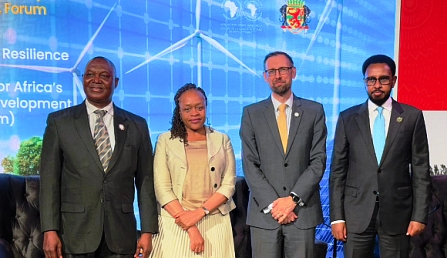
New framework targets $400 billion annual financing gap as pilots begin in Liberia, Somalia, Mozambique, and Djibouti.
The African Development Bank Group (AfDB) and the World Economic Forum (WEF) on Wednesday launched the Humanitarian and Resilience Investing (HRI) Roadmap for Africa to channel private investment into the continent’s most fragile economies.
The HRI Roadmap for Africa sets out a coordinated, country-led approach to mobilising commercial and catalytic capital in underserved frontier markets and transition states—regions where the investment gap is most acute and the enabling conditions for private investment have historically been weakest.
Addressing Africa’s $400 Billion Financing Paradox
The roadmap’s development responds to a structural paradox at the heart of Africa’s financing challenge: the continent faces an annual development financing gap of approximately $400 billion.
Despite having 17 percent of the world’s population, Africa attracts only 3.5 percent of global foreign direct investment and less than 2 percent of global venture capital. Shifting geopolitical dynamics and contracting official development assistance have further intensified the urgency.
Pilot countries are already underway in:
- 🇱🇷 Liberia
- 🇸🇴 Somalia
- 🇲🇿 Mozambique
- 🇩🇯 Djibouti
“A Paradigm Shift from Aid Dependency to Investment-Led Development”
In keynote remarks, Marie-Laure Akin-Olugbade, African Development Bank Group Senior Vice President (speaking on behalf of President Dr. Sidi Ould Tah), underscored the urgency of the moment.
“The time for a paradigm shift, from aid dependency to investment-led development, is now. The HRI Roadmap creates that foundation. It clarifies roles. It sequences interventions. It positions public and development finance where it belongs: as a catalyst, not a substitute.”
Ms. Sheba Crocker, Managing Director of the World Economic Forum, added:
*“The world’s most vulnerable communities deserve more than relief—they deserve investment in the businesses and economies that allow them to thrive on their own terms. Built on the global HRI initiative and backed by more than 100 partners, this Roadmap reflects our determination to move beyond fragmentation and toward the coordinated, investment-led approaches that Africa’s frontier markets urgently require.”*
Catalysing Investment in Frontier Markets
Dr. Abdul Kamara, Acting Vice President for Regional Development, Integration and Business Delivery, moderated a panel discussion following the high-level remarks.
Panellists included:
- Sheba Crocker – Managing Director, World Economic Forum
- Bihi Iman Egeh – Minister of Finance, Somalia
- Chris Bold – Director, International Financial Institutions Department, UK Foreign, Commonwealth and Development Office (FCDO)
- Sara Mbago-Bhunu – Director, East and Southern Africa Division, International Fund for Agricultural Development (IFAD)
Key Panel Insights
Minister Egeh argued that Somalia does not lack entrepreneurship but suffers from de-risking gaps and exclusion from correspondent banking.
Mbago-Bhunu drew on examples from IFAD’s work with smallholder farmers—including a digital-voucher scheme with Kenyan commercial banks—to make the case that rural and peri-urban implementation will require integrated financial, digital, and infrastructure tools, not isolated interventions.
Chris Bold explained that FCDO is steering its development finance institutions toward fragile states that rely on concessional capital. He pointed to Kenya’s M-Pesa mobile money system as proof that creating new markets depends as much on regulatory reform as on capital.
Roadmap Presentation and Strategic Alignment
Mr. Bumi Camara, AfDB Chief Fragility and Resilience Economist, made a presentation on the roadmap.
Full roadmap available at: https://apo-opa.co/3PM4dKI
The Roadmap embeds climate resilience and gender inclusion as core pillars. It aligns with:
- The African Development Bank’s Four Cardinal Points strategic compass
- The New African Financial Architecture for Development (NAFAD) , endorsed through the Abidjan Consensus in April 2026
- The Bank’s Affirmative Finance Action for Women in Africa (AFAWA) – which to date has disbursed $1.33 billion to women-led businesses across 45 countries