By
By 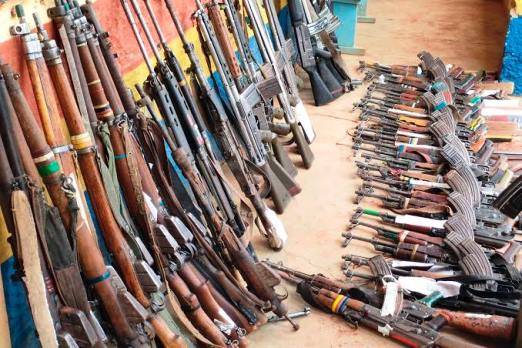
By Onyilokwu David Adeyi
The bandit camps hidden deep in the Rugu, Kuyanbana and Falgore forests of North-West Nigeria are not short of firepower. In the first half of 2025 alone, at least 2,266 people were killed by bandits and insurgents across the country more than the total recorded for the whole of 2024.
Much of that carnage was concentrated in Zamfara, Katsina, Sokoto, Kebbi, Kaduna and Niger states, where armed groups now move with a confidence that only comes from having more guns, and often better guns, than the security forces sent to confront them.
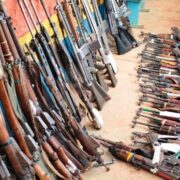
This is no longer a story about criminal gangs with a handful of stolen rifles. It is a story about the unchecked proliferation of small arms and light weapons (SALW), and it deserves to be treated as the national emergency it has become.
A country awash with weapons
Nigeria has never had a reliable count of the guns within its borders, and that uncertainty is itself part of the problem. The Office of the National Security Adviser once put the figure at roughly one million SALW in circulation.
Independent researchers and the Small Arms Survey have suggested numbers many times higher, with some estimates placing between six and eight million firearms in civilian hands alone, the overwhelming majority unlicensed and untraceable. Whichever figure one accepts, the pattern is the same: ordinary Nigerians, criminal syndicates and armed groups possess more weapons than the police and the armed forces combined.
In the North-West specifically, this abundance of weaponry has transformed banditry from a nuisance into an insurgency in all but name. Groups once associated with cattle rustling and highway robbery now field assault rifles, rocket-propelled grenades and, increasingly, weaponized drones.
Some networks, such as the Mali-linked Lakurawa group operating across Sokoto and Kebbi, have begun to fuse criminal banditry with jihadist ideology, borrowing tactics and, worryingly, arms-supply routes from Boko Haram and Islamic State affiliates in the Sahel.
Four drivers, one crisis
The reasons this problem has metastasized are not mysterious. They are well documented, and they are largely of our own making.
Weak state security sits at the root of it. Nigeria’s land borders stretch across thousands of kilometers of largely ungoverned terrain shared with Niger, Chad, Benin and Cameroon. Customs and immigration posts are thinly staffed, poorly equipped and, in many places, simply absent.
Weapons move across these frontiers on donkeys, motorcycles and commercial trucks with the same ease as smuggled fuel or contraband rice. A security apparatus stretched across insurgency in the North-East, militancy in the Niger Delta and secessionist agitation in the South-East has few resources left to police its own borders.
Corruption compounds this failure at every link in the chain. Weapons meant for licensed dealers, private security firms or even the armed forces routinely find their way onto the black market. Investigations over the years have implicated serving and retired security personnel, complicit customs officials and politically connected arms importers who exploit murky licensing procedures. When a rifle recovered from a bandit camp can be traced back to an official armory, the state’s monopoly on legitimate force becomes a fiction.
Local weapons manufacturing now a booming industry
Local weapons manufacturing has quietly become an industry of its own. Craft producers in the South-East and parts of the Middle Belt fabricate functional firearms from single-barrel pistols to rifles capable of firing military-grade ammunition often within workshops that operate with impunity.
What began as small-scale, low-caliber production has evolved, with craft gunsmiths now reportedly capable of manufacturing weapons that rival factory-made arms in lethality, at a fraction of the cost and with none of the paperwork.
Terrorism financing provides the fourth and most dangerous ingredient. Ransom payments from kidnapping-for-ransom, illegal mining of Zamfara’s gold and other mineral deposits, and levies extorted from rural communities have given bandit groups a war chest to purchase increasingly sophisticated weaponry. This is a self-reinforcing economy: guns enable kidnapping, kidnapping funds more guns, and the cycle accelerates with every passing year.
The human cost is not abstract
Behind every statistic is a village emptied, a farmer too afraid to reach his fields, a school shuttered indefinitely. Displacement across the North-West now numbers in the hundreds of thousands. Food insecurity in Zamfara and neighboring states has worsened as farmers abandon land they can no longer safely cultivate, feeding a hunger crisis that will long outlast any single military operation.
Meanwhile, military responses such as the 2016 “Operation Harbin Kunama” have at times done more to scatter and radicalize bandit networks than to dismantle them, illustrating that firepower alone, deployed without a parallel strategy to choke off arms supply, cannot solve a problem rooted in availability.
What must be done
Nigeria does not lack policy documents on this issue; it lacks the political will and institutional capacity to implement them. The National Centre for the Control of Small Arms and Light Weapons exists, along with a National Action Plan, but both remain chronically underfunded and poorly coordinated with state governments, who are constitutionally barred from raising their own security forces yet bear the brunt of the violence.
Several concrete steps deserve urgent priority.
First, border security must be modernized and properly resourced, not merely militarized. Biometric tracking, drone surveillance and intelligence-sharing arrangements with Niger, Chad and Benin would do more to intercept arms shipments than additional checkpoints manned by underpaid, under-equipped personnel. This requires sustained budgetary commitment, not one-off allocations announced after each mass-casualty attack.
Second, a genuine national weapons registry and audit of both civilian and institutional stockpiles is overdue. Nigeria cannot control what it cannot count. A transparent, digitized licensing and tracing system backed by serial-number recording and cross-agency data-sharing would make it far harder for weapons to disappear from official inventories into criminal hands.
Third, corruption within the security and customs services must be confronted directly, including independent, well-resourced investigative units empowered to prosecute officials implicated in arms diversion, with sentences that reflect the gravity of enabling mass violence rather than the token penalties typical of past cases.
Nigeria must deepen cooperation with external partners
Fourth, craft weapons production requires a dual approach: aggressive enforcement against illegal workshops, paired with economic alternatives for the communities that depend on this trade. Criminalization alone has failed for years precisely because it ignores the poverty that sustains the industry.
Fifth, the financial lifelines of armed groups must be severed. This means tightening scrutiny of ransom payments, disrupting illegal mining operations that fund bandit economies, and strengthening the Nigerian Financial Intelligence Unit’s capacity to trace and freeze assets linked to armed groups.
Finally, none of this can succeed in isolation. Nigeria must deepen cooperation with the Economic Community of West African States and international partners such as the United Nations Office on Drugs and Crime, building on frameworks like the ECOWAS Convention on Small Arms and Light Weapons, which has existed since 2006 but has never been implemented with the seriousness the crisis demands.
A test of political will
The proliferation of small arms in North-West Nigeria is not an intractable mystery. It is a well-understood problem, with well-understood solutions. What has been missing is not knowledge but resolve the willingness of federal and state authorities to treat arms control as a strategic priority rather than a footnote to counter-insurgency operations.
Every week that passes without decisive action on borders, corruption, craft production and terrorism financing is a week in which more weapons flow into communities that can least afford them.
Nigeria’s leaders have the evidence, the frameworks and the international partnerships needed to act. What remains to be seen is whether they possess the political courage to use them before the next attack, rather than after.
Onyilokwu David Adeyi, Intern. Institute for Peace and Conflict Resolution (IPCR), Abuja. Nigeria.