By
By 
An open letter to Ajay Banga on thirty years of flat governance and the case for structural accountability.
Dear President Banga,
“When I endeavor to examine my own conduct… I divide myself, as it were, into two persons… The first is the spectator… The second is the agent, the person whom I properly call myself.”
In 1759, Adam Smith, father of modern economics, set out this idea in The Theory of Moral Sentiments. Smith’s “impartial spectator” is the disciplined act of stepping outside oneself to judge one’s own conduct honestly. More than two and a half centuries later, this wisdom remains entirely valid.
I write this letter in that spirit — not as an adversary, but as a practitioner who has spent a career in public financial management and governance across the Middle East and Sub-Saharan Africa, and who believes the Bank can, and must, do better. The Bank possesses the knowledge and convening power that, combined with willing and committed governments, can meaningfully improve lives across our continent.
The Data Speak for Themselves
For close to thirty years, Sub-Saharan Africa has made little meaningful progress on the governance metrics that matter most. The World Bank’s Worldwide Governance Indicators (WGI) show this clearly across four critical dimensions: control of corruption, rule of law, government effectiveness, and regulatory quality.
These are precisely the dimensions that determine whether African governments can mobilise domestic revenue and access global capital markets. Alarmingly, in several of these areas, the region has not just stagnated but regressed.. World Bank disbursements to the region reached $108.5 billion over FY2018–2024 alone.
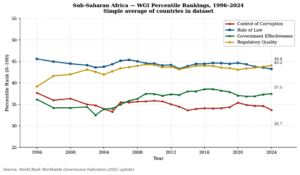
Figure 1. Sub-Saharan Africa — WGI Percentile Rankings, 1996–2024 (simple average of countries in dataset). Source: World Bank Worldwide Governance Indicators (2025 update).
The numbers are unambiguous. Control of Corruption has drifted downward from a percentile rank of 37.7 in 1996 to 33.7 in 2024. Rule of Law has declined from 45.6 to 43.2. Government Effectiveness has flatlined with no sustained improvement. Only Regulatory Quality registers a modest gain, from 39.1 to 44.0, over the entire period. The overriding story is not dramatic reversal but stagnation despite massive investment.
The flatness of four lines across nearly three decades of concessional and non-concessional financing raises two questions that go to the heart of the Bank’s mission: have these interventions built the institutional foundations for self-reliant development, and has the debt this financing created been justified by the value actually delivered on the ground?
The Internal Scorecard: CPIA Trends
The Country Policy and Institutional Assessment (CPIA) is produced annually by World Bank staff and is the primary instrument through which International Development Association (IDA) allocations are calibrated. I take it entirely at face value — it is, after all, the Bank’s own instrument. The WGI, by contrast, is the closest proxy available for an impartial spectator: independent, externally compiled, and benchmarked globally.
As Figure 2 shows, both instruments tell the same story: the regional average has remained essentially flat since 2005, with the Public Sector Management and Institutions cluster — the one most directly tied to fiduciary risk — consistently registering as the lowest-scoring of the four.
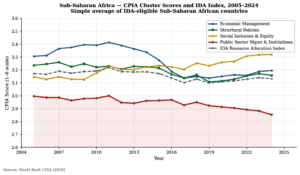
Figure 2. Sub-Saharan Africa — CPIA Cluster Scores and IDA Index, 2005–2024 (simple average of IDA-eligible Sub-Saharan African countries). Source: World Bank CPIA (2024).
The Accountability Gap
I acknowledge that you have reduced the Bank’s internal scorecard from 150 metrics to 22. That is a welcome rationalization. But it does not resolve the structural problem. The Bank is simultaneously the lender, the project designer, the provider of technical assistance, and the evaluator of its own results.
That is a principal-agent problem that no reduction in metric count can resolve. After thirty years of flat external indicators, the reasonable inference is not that the Bank needs a more compact internal scorecard. It is that internal scorecards are structurally incapable of producing the accountability this situation requires, because the institution has no incentive to report systemic failure.
This is precisely the failure Adam Smith’s impartial spectator would confront. Looking at the WGI data alongside the CPIA scores used to determine IDA allocations, two questions demand a forthright answer:
Is the World Bank saddling Sub-Saharan Africa with debt whose carrying cost exceeds the economic value of the projects financed and implemented, in environments of institutional weakness and pervasive corruption that the Bank’s own data document?
The trend data point strongly in one direction. What remains is this: what structural changes in incentives — for borrowing governments and for the Bank itself — are needed to create the conditions for African economies to finance their own development through domestic and global capital markets?
A Question That Has Waited Thirty Years
There is a humbling precedent. In 1995, your predecessor James Wolfensohn attended a dinner hosted by Henri Konan Bédie, President of Côte d’Ivoire. Introduced to a chef who had worked at the Élysée Palace in Paris, Wolfensohn was moved to ask whether World Bank money was actually being spent as intended — a moment he recounts in his memoir, A Global Life. That reflection helped place corruption at the center of the development agenda for the first time in the Bank’s history. A generation later, the question remains as valid as it was that evening in Abidjan. The governance data confirm it.
Development economist Stefan Dercon, in Gambling on Development, describes a reality familiar to any practitioner in this field: in many of these countries, two governments exist in effect — the formal one the Bank transacts with, and the elite political settlement that makes real allocation decisions, including channelling project contracts to political allies and insiders. Three decades of WGI data do not contradict that observation. They reinforce it.
Five Proposals
While acknowledging IDA’s transition to grant-only financing for Least Developed Member Countries and the new Program-for-Results initiative, I offer five concrete measures to change the incentive structure on both sides of the lending relationship, the first of which provides the institutional architecture on which the other four depend.
- Establish an independent external evaluation body, insulated from the Bank’s administrative structure, with a mandate to assess on a rolling basis whether Bank lending in developing countries is generating the development outcomes and institutional capacity gains that justify the debt it creates.
Paul Volcker, former Chair of the Federal Reserve, reflecting on a recommendation made by a commission he chaired to review the integrity of World Bank projects, wrote in his autobiography Keeping At It: “I greatly regret the World Bank has not continued the oversight board my group recommended.” That lapsed mandate should be revived. Thirty years of self-reported results against flat external indicators is not a vindication of the current model. It is an argument for external scrutiny. The four operational proposals that follow are only credible if this architecture exists.
“Leaders want to survive politically, and they generally want to be seen as effective”
- Link World Bank Group financing directly to verified improvement in the four governance indicators presented above.
Development finance is fungible: Bank disbursements free up domestic resources for purposes unrelated to development. The Bank should upgrade its internal procedures to ensure that money is deployed where it will demonstrably serve development. The leverage exists: leaders want to survive politically, and they generally want to be seen as effective; genuine reform becomes feasible when they conclude that their political survival requires it.
- Require, prior to project approval, that the Bank certify the existence of a credible fiduciary system and that the project’s projected economic return equals or exceeds its full cost of financing — including the sovereign debt service it creates.
This shifts the burden of proof upstream, before commitments are made, rather than after funds are disbursed and accountability becomes difficult to assign.
“Transparency of this kind does not require new instruments — it requires the political will “
- Publish an annual ranking of Sub-Saharan African countries by fiduciary standards as a prominent feature of the Bank’s flagship reporting.
Ministers of finance operate in a regional peer environment — they attend the same summits, sit on the same boards, and compete for the same investor attention. A transparent public ranking creates accountability that is harder to ignore than a private bilateral conversation: no minister wishes to be seen by peers as presiding over a system that cannot account for public resources. Countries near the bottom face reputational pressure to act; countries at the top have an incentive to maintain their standing, which will incentivize and assist ministers in their efforts to improve fiduciary standards at home. Transparency of this kind does not require new instruments — it requires the political will to use what the Bank already produces.
- Where the Bank certifies a project as viable and that certification proves wrong, it should bear a defined share of the cost.
As Prime Minister Anwar Ibrahim of Malaysia has observed: for every bad borrower, there is a bad lender. The poor citizens of Sub-Saharan Africa should not be made the sole bearers of bad lending decisions. The mechanism could take the form of fee reductions, haircuts on administrative charges, or contributions to a country-level remediation fund. This does not threaten the Bank’s preferred creditor status, which governs repayment priority in sovereign distress — not fee income on underperforming projects. And if the prospect of shared loss sharpens the quality of upstream certification, a stronger portfolio is the result — which is precisely what protects the Bank’s rating.
A Final Note of Realism
I harbor no illusions about institutional inertia. But the cost of inaction is not abstract. If governance scores across Sub-Saharan Africa remain essentially unchanged a decade from now—just as they have stayed stagnant since 1996—the consequences will be severe. The World Bank will have deployed another large tranche of capital against weak, unmoving institutional foundations. Meanwhile, another generation of Africans will be left servicing the debt on projects that failed to transform their lives.
The impartial spectator asks us to judge conduct not as we wish it to be seen, but as it actually is. That honest reckoning is both overdue and within your power to initiate, Mr. Banga. I hope these reflections merit some consideration.
 Author: Aboubakr Kaira Barry, CFA, is Managing Director of Results Associates and has spent over two decades working on public financial management reform in Sub-Saharan Africa and the Middle East.